
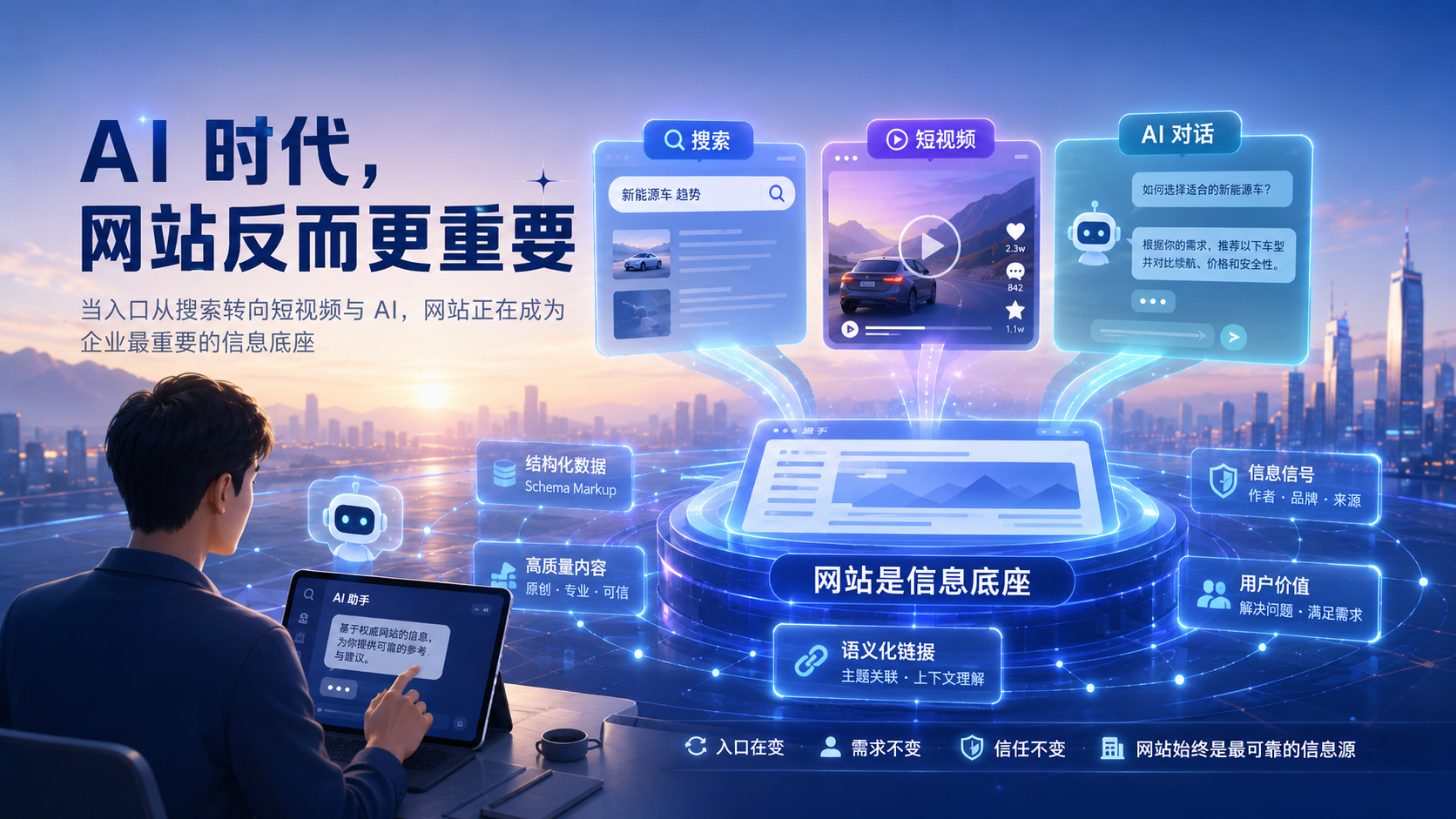
The information entry is changing, but AI still relies on internet sources to answer questions. A company website is no longer only a display window for users. It becomes a key data source for AI to understand, verify and recommend the company.
In the AI era, are websites really becoming less useful?
When talking with several friends recently, I noticed an interesting assumption: many people seem to believe websites are becoming less important.
In the past, users searched keywords, opened different websites and read content. Later, short-video platforms changed information habits. In the past two years, AI has spread quickly, and many users now ask AI directly instead of searching first.
That leads to a common judgement: are websites becoming useless? On the surface, it seems reasonable. Users do visit official sites less actively, and many brand sites receive less traffic than before.
But if we only look at this surface change, we miss a deeper logic: users asking AI means the entry point has changed, but the information AI uses to answer still comes from the internet.
Websites are not becoming unimportant; their role is changing
AI does not magically know who a company is, what services it provides, what advantages it has or whether it deserves recommendation. It must understand, judge and verify you through public information.
One of the most important sources of that public information is still the website. That is why I think business websites will not become less important in the AI era. They will become more important than before.
The role has changed. In the past, websites were mainly for humans. Companies built websites so users could see brand introductions, products, services, cases and contact methods, then inquire or convert.
Future websites must serve both humans and AI. If AI Q&A becomes a mainstream information entry, the company website becomes a key data source for AI to understand the business.

Before, websites affected search ranking; next, they affect AI recommendations
Whether your content is clear, page structure is reasonable, information is accurate, service boundaries are explicit, and cases and evidence are sufficient will all affect how AI understands you.
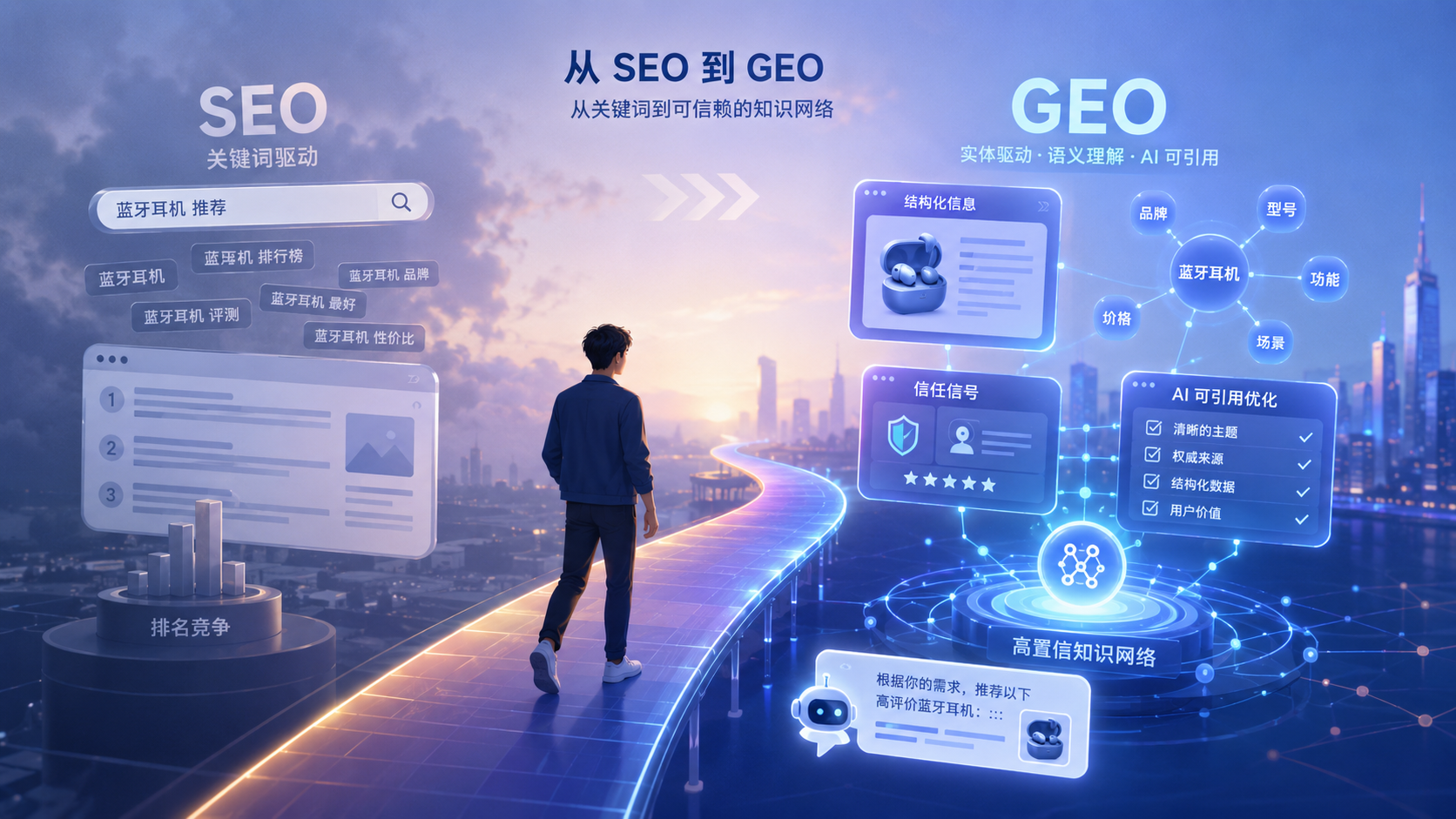
In other words, websites used to affect search rankings. In the future, they will affect whether AI is willing to recommend you. This is the shift from SEO to GEO.
In the SEO era, we cared more about keywords, ranking, indexing, backlinks and click-through rate. In the GEO era, the focus changes.
Companies should not simply spread keywords. They must help AI accurately understand who they are, what problems they solve, which customers they fit, how they differ from competitors and why they deserve trust.
Future websites need structure, not just content
This means a website needs not only content, but structure. Every page should have a clear topic.
Products and services should be expressed in a structured way. Cases, industries, scenarios and customer problems should be connected. Pages should also form clear logical relationships.
External content should also support official-site content as evidence. Ultimately, companies need to build a high-confidence information system.
Only then can AI understand, trust and recommend the company in the right scenarios when answering user questions.

Many company websites need reconstruction, not just redesign
Many company websites may need to be rebuilt. This is not simply a visual redesign or making pages look better. It is an upgrade from a website for browsing to an information asset that AI can understand.
The first key change is that website content must move from marketing slogans to clear and credible information.
Many company websites sound the same: professional team, industry-leading, one-stop solution, empowering growth. Humans feel little from these phrases, and AI cannot easily judge where the company is truly strong.
Future website content must be more specific, structured and verifiable: who do you serve, what problem do you solve, which scenarios fit, what is the delivery process, what cases prove it, and what advantages exist compared with alternatives? The clearer these facts are, the easier AI can understand you.
Pages must become a content network instead of isolated pages
The second key change is that pages must move from isolated pages to a content network. Many company sites used to have only separate pages such as About, Products, Cases and Contact.
But AI needs to understand relationships between information. If a company offers GEO optimization, its site should not only have one GEO service page.
It should also answer: what is GEO, how is GEO different from SEO, which industries fit GEO, how should company websites adapt to AI search, how does AI judge brand trust, what content assets does GEO need, and how should structured data be implemented?
When these pieces connect with each other, AI can form a more complete understanding.
Websites must upgrade from being indexed to being trusted by AI
The third key change is that websites must move from being indexed by search engines to being trusted by AI. In the SEO era, if a search engine could crawl your site, you had a chance to rank.
In the AI era, being crawled is not enough. AI cares more about whether information is consistent, clear, evidenced and verifiable across sources.
So besides the official website, companies also need external content such as industry articles, media coverage, case releases, social content and third-party platform information. Together, these form the basis of AI's judgement.
When official-site information is clear and external content provides supporting evidence, the company has a better chance to become a trusted source in AI answers.

Websites will not disappear; they will become the company's information foundation
This is why I believe websites will not disappear. They will upgrade. Future websites are no longer just display windows. They become the information foundation of a company in the AI world.
Users may not directly visit your website, but AI will visit, understand, extract and summarize it. Users may not click into your site, but AI's recommendation of you may come from your website content.
So the question is not whether websites still matter. The question is: is your website ready to be understood by AI?
If your website is still a traditional official site that only shows company introduction, products, services and contact methods, it may struggle to create real value in the AI era.
GrowthOS helps websites serve humans and become understandable to AI
If your website can complete content structuring, page relationship building, semantic optimization and external evidence support, then it is not just an official site. It becomes an important asset for entering AI Q&A channels.
This is what GrowthOS is building. We help companies adopt AI-era website growth: use AI to organize page structure, optimize SEO/GEO content, generate structured data, and build an information system around products, services and user scenarios that AI can understand and trust more easily.
Simply put, your website should not only be readable by humans. It should also be understandable to AI.
In the future, where users ask questions is not the key. The key is whether AI can understand you, trust you and recommend you when users ask.
FAQ
As discovery moves from search to short video and AI, websites do not disappear. They become the information foundation that AI can understand and trust.
Why are websites still important in the AI era?
Because AI answers still depend on public internet information. The company website is one of the core sources for understanding brand, services, cases and credibility.
Who should future websites serve?
Both humans and AI. Users may not visit the site directly, but AI will visit, understand, extract and summarize it.
What changes from SEO to GEO?
SEO focuses more on keywords and ranking. GEO focuses on whether AI can understand, trust and recommend the company, so structure, semantic relationships and evidence matter more.
What does GrowthOS do here?
GrowthOS helps organize page structure, optimize SEO/GEO content, generate structured data and build an information system AI can understand and trust.