
Preface: Websites Are Not Obsolete; They Are Being Redefined
Over the past few years, many businesses have changed the way they think about websites.
In the past, companies built official websites so customers could find them through search engines. When customers had a need, they searched keywords on Baidu or Google, clicked through to a website, browsed products, case studies, and service descriptions, and then submitted a form or contacted sales.
Later, short-video, social media, and content platforms grew rapidly and fragmented users' attention. Many customers stopped actively visiting official websites and instead obtained information from platforms such as Douyin, Xiaohongshu, Bilibili, WeChat Channels, LinkedIn, and YouTube.
Over the past two years, AI Q&A has become another new gateway.
Users have started asking AI directly:
"Which company is suitable for building an export-focused independent website?" "Which suppliers in a certain product category are reliable?" "Who should I hire for GEO optimization?" "Which service providers in this industry are worth recommending?" "What is the difference between one brand and another?" "I need an AI customer-service system for a small or medium-sized business. What options are available?"
On the surface, websites seem to be becoming less and less important.
Users may no longer actively open an official website, browse its content page by page, or click through from search results.
But focusing only on this surface change misses a more important underlying principle:
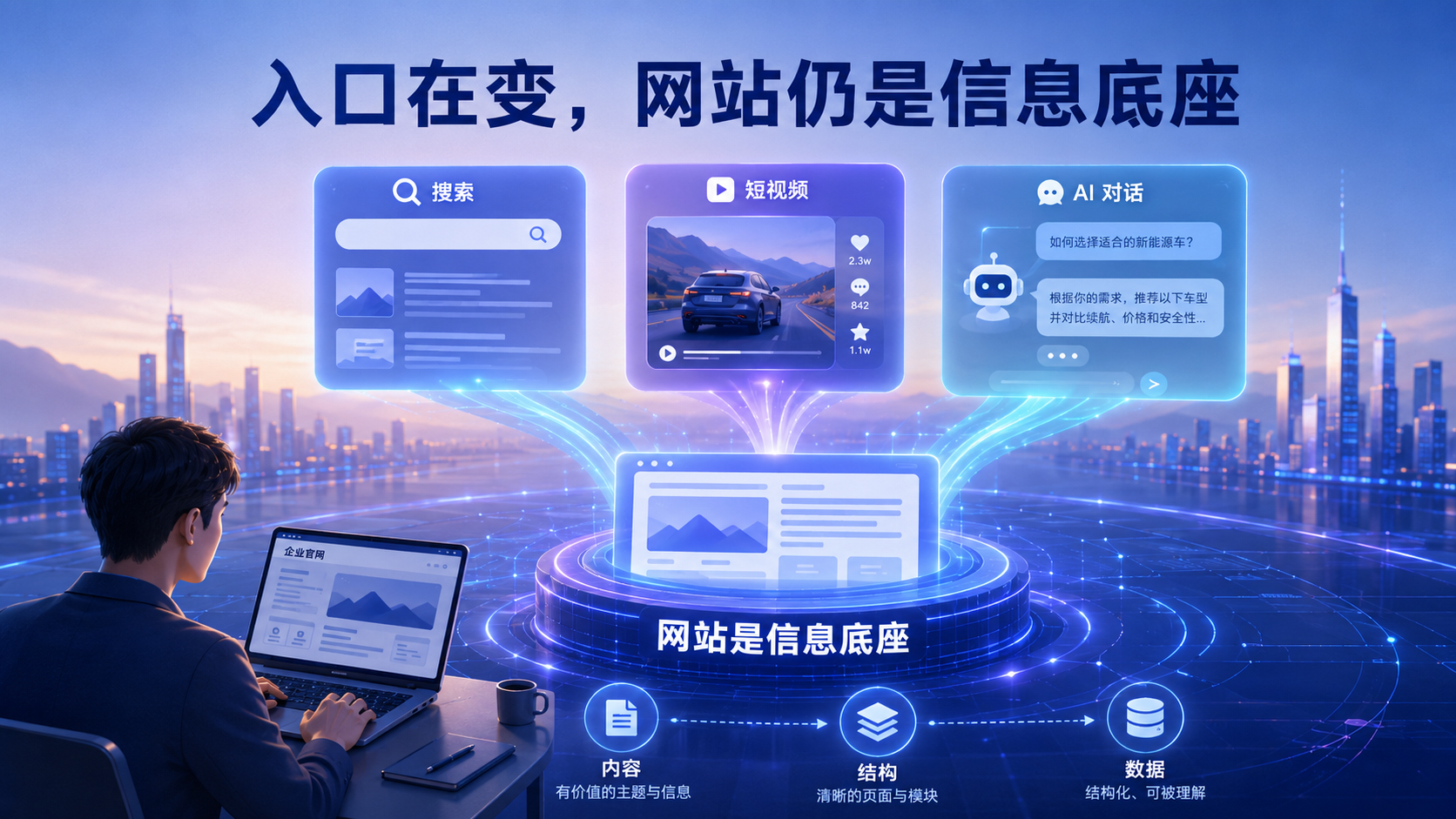
The gateway has changed, but the sources of information have not disappeared.
AI still needs information sources to answer users' questions. It still needs evidence to determine whether a company is trustworthy. To recommend a brand, service, or product, AI still needs to understand who the company is, what it does, whom it serves, what case studies it has, and whether its public information is stable and consistent.
The most central, stable, and controllable source of this information remains the company's official website.
So websites have not become unimportant.
On the contrary, websites will become even more important in the AI era.
Their role has simply changed.
Websites used to be display windows designed for people. Future websites will be information foundations that AI can understand, users can trust, sales teams can convert through, and brands can build on over the long term.
GrowthOS was created in precisely this context.
The problem it addresses is not simply adding an AI chat window to a website, nor is it limited to traditional SEO ranking optimization.
What GrowthOS aims to do is:
Help businesses upgrade traditional websites into intelligent website systems for the AI era that can be understood, cited, recommended, used to receive customers, used to drive conversions, and improved for sustainable growth.
Chapter 1: Websites Used to Be Primarily Display Windows
In the traditional internet era, business websites delivered value in three main ways.
1. Presenting the Corporate Image
The earliest role of a website was to serve as a company's online business card.
After entering a website, customers could see:
Company information; products and services; case studies; qualifications and honors; contact details; news and updates; form entry points.
At this stage, the website's priority was to "look professional."
The page design needed to be attractive, the visual language consistent, the content complete, and the contact information clear.
For many companies, website development was considered complete as long as an official website existed and customers could see basic company information.
2. Capturing Search Traffic
Later, search engines became the primary gateway through which users found information.
Businesses began investing in SEO.
Websites were no longer used only for display; they were also expected to acquire customers.
Companies optimized keywords, titles, descriptions, internal links, external links, and article content in the hope that their websites would rank near the top when users searched for relevant terms.
At this stage, the value of a website became:
Being indexed by search engines; ranking for target keywords; capturing organic search traffic; guiding users toward inquiries and conversions.
3. Supporting the Sales Process
The websites of many B2B companies, export businesses, and service providers also served as sales support materials.
When communicating with customers, salespeople sent them links to the official website.
Customers used the website to determine:
Whether the company was legitimate; whether its product offering was complete; whether its case studies were credible; whether its services were professional; whether further discussion was worthwhile.
At this stage, the website was still primarily "for people to read."
Users actively visited the website. Users read the pages themselves. Users decided for themselves whether to trust the company. Users decided for themselves whether to leave a lead.
The core logic of traditional website development was therefore:
Prioritize page presentation, human browsing, and keyword rankings.
This logic worked in the search era.
But in the AI era, it is no longer enough.
Chapter 2: The Role of Websites Is Changing in the AI Era
AI Q&A has changed how users obtain information.
Instead of opening a dozen websites and comparing them personally, users can give the question directly to AI.
For example:
"Recommend several independent-website service providers suitable for export businesses." "Which company is suitable for multilingual SEO and GEO optimization?" "Which scenarios is a certain product suitable for, and who supplies it?" "Is this brand reliable?" "Which solution is suitable for our company?"
AI then performs part of the information screening, summarization, and evaluation on the user's behalf.
This means a business website can no longer simply wait for users to visit it.
It must also become an important source through which AI understands the business.
Future websites will assume at least four new roles.
1. The Website Is the Company's Primary Source
A business may have many sources of information across the internet.
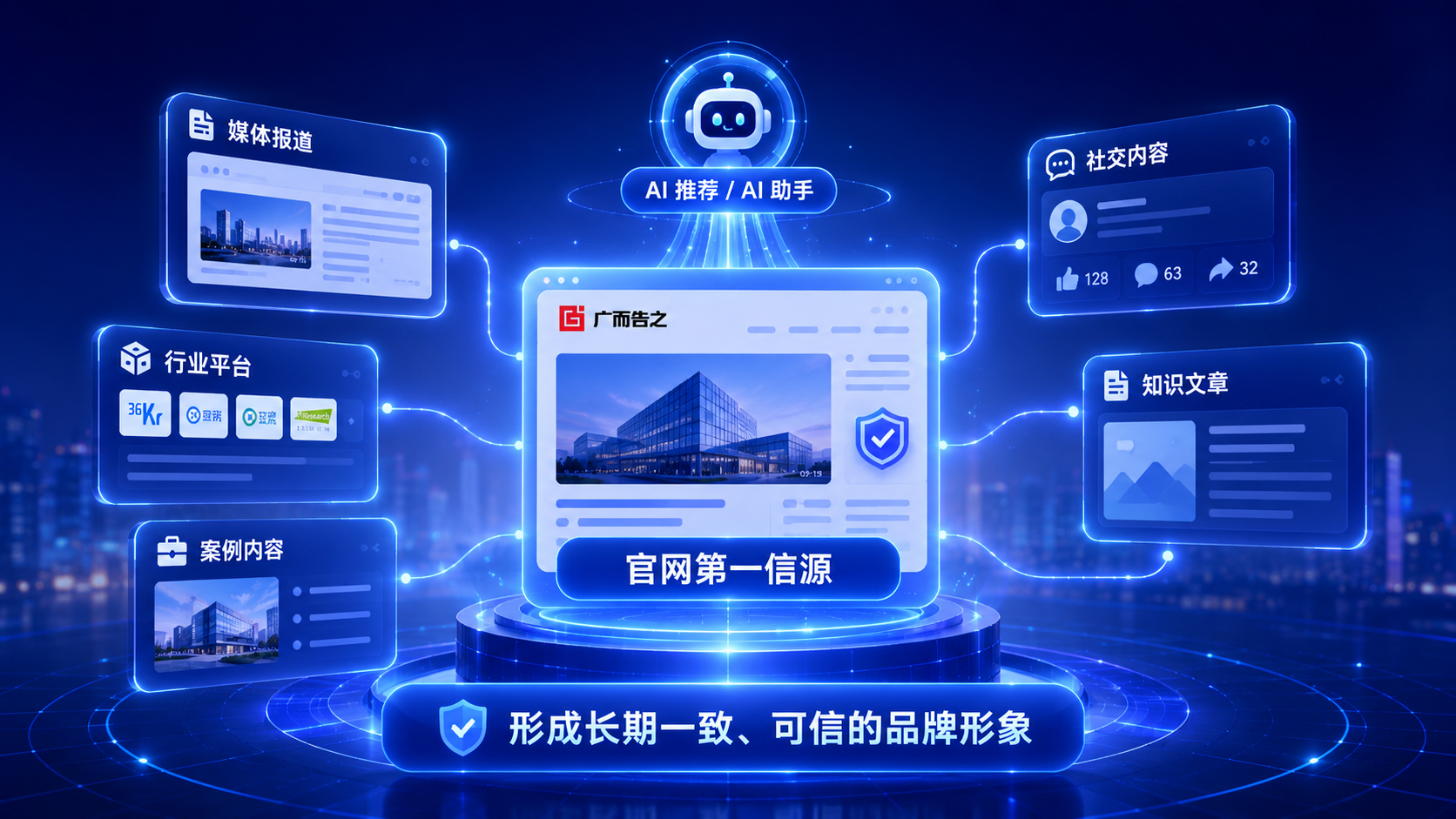
Official websites, press releases, short videos, social media accounts, third-party platforms, industry directories, media coverage, customer reviews, Q&A content, product catalogs, and encyclopedia entries may all be read by AI.
Among these sources, the official website should provide the most stable, complete, and accurate expression of company information.
The official website should become the company's primary source.
In other words, the official website should be the first place to clearly explain who the company is, what it does, whom it serves, what products it offers, what case studies it has, how it can be contacted, and what the brand stands for.
If the official website cannot explain the company clearly, information on external platforms is even more likely to become confused.
When AI tries to understand a company, it faces a large volume of fragmented information.
If the official website is incomplete, external content is inconsistent, brand names are used interchangeably, product descriptions are confused, and service boundaries are vague, AI will struggle to form a stable judgment.
The primary value of the future official website is therefore to become the company's authoritative information source in the AI world.
2. The Website Is AI's Gateway to Understanding the Business
In the past, it was enough for people to understand a website.
In the AI era, the website must also be understandable to AI.
This is not merely a slogan.
When AI reads a web page, it does not only look at the words on the page. It also needs to understand the relationships between them:
Which company does this page belong to? Is it a homepage, article page, product page, service page, or FAQ page? What is the page's core entity? What services does the company provide? Which scenarios is the product suitable for? What questions can the article answer? How are these pages related? Which content can be cited? Which information deserves trust?
Traditional websites often have content but lack structure.
People can look at a page and understand it approximately. AI may be able to extract some text, yet still fail to identify the page's topic, entities, relationships, and credibility accurately.
Future websites must therefore upgrade from "content display" to "information organization."
This is why GEO emerged.
3. The Website Is the Center Where Brand Credibility Accumulates
When AI recommends a company, it does not consider only what the company says about itself.
It is also influenced by external information.
For example:
Has the company received media coverage? Is it listed on industry platforms? Is third-party content consistent? Does it communicate continuously on social media? Are its customer cases genuine? Is product information consistent across multiple sources? Have the brand name, official website, and service descriptions remained stable over time?
The official website is the primary source; external content provides supporting evidence.
Only when the two work together can they form a trustworthy brand information network over the long term.
If the official website says one thing, external platforms say another, and social media communicates something else again, AI will be less able to form a stable judgment about the brand.
Future websites therefore will not exist in isolation.
They must work with external content to build a consistent, long-term understanding of the brand.
4. The Website Is the Front Desk for Customer Inquiries and Conversion
A website in the AI era must not only be understood; it must also be able to receive customers.
This is especially important for export websites and B2B inquiry websites, whose customers may come from different time zones, language environments, and channels.
After opening the website, a customer may want to ask:
What are the product specifications? What is the price range? Is customization supported? How long is the lead time? Are certifications available? Can you send product materials? Are there overseas case studies? Are small-volume purchases supported? How can I get in touch through WhatsApp?
If the website consists only of static pages, customers cannot find answers, and no one responds promptly, the lead is likely to be lost.
Future websites therefore also need AI-powered customer reception.
When customers arrive, someone receives them. When customers ask questions, someone answers. When customers request materials, those materials can be sent automatically. When customers show intent, they can be transferred to a human salesperson. What customers ask about can be captured as leads.
This means the website is evolving from a "display window" into a "growth system."
Chapter 3: What Is GEO?
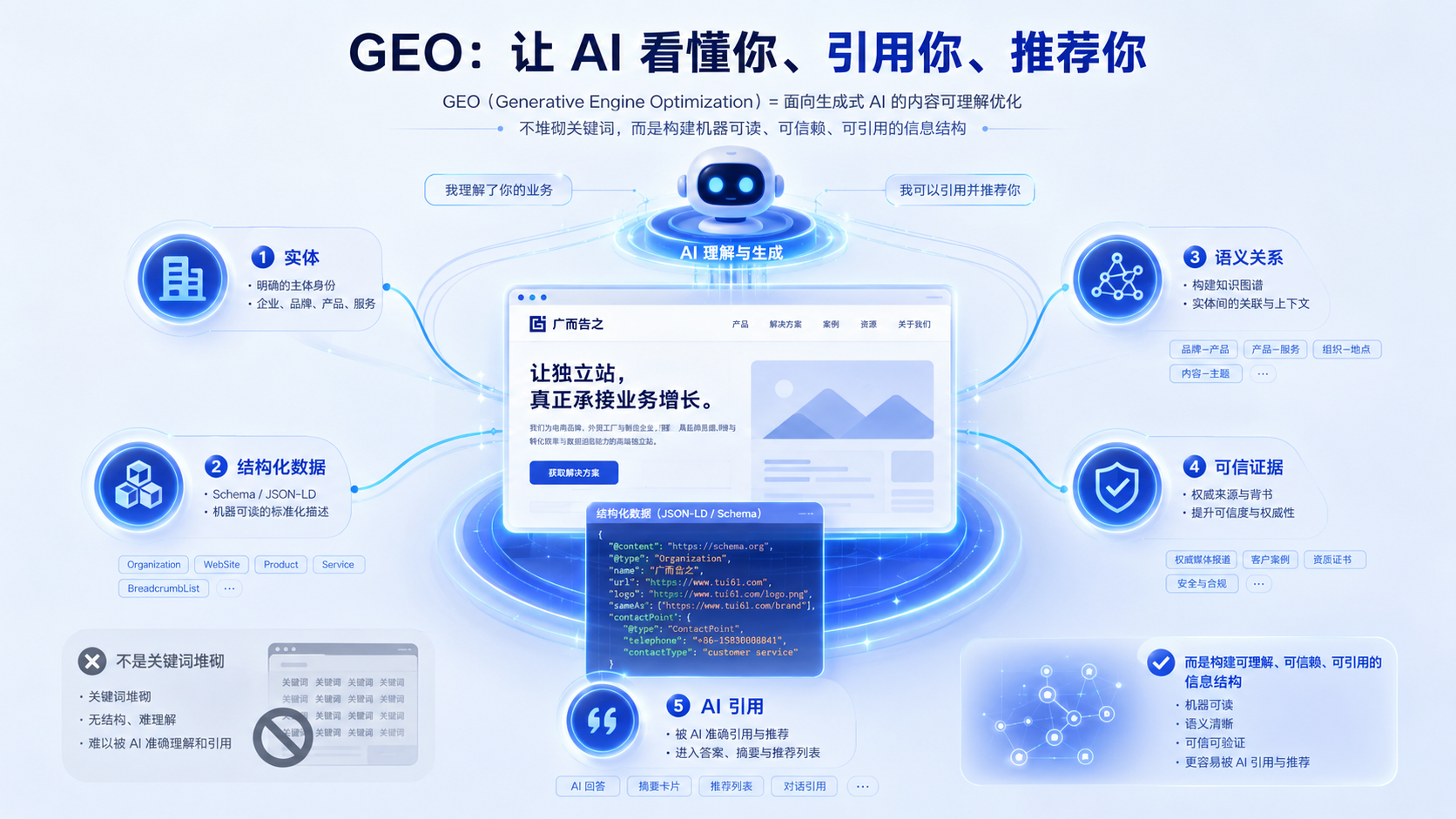
GEO can be understood as website optimization for generative AI and AI search scenarios.
If SEO addresses the question:
When users search for keywords, can the search engine find you, and can you rank near the top?
Then GEO addresses the question:
When users ask AI a question, can AI understand you, trust you, cite you, and recommend you in the appropriate context?
GEO is not simply SEO under a different name.
The object of optimization has changed.
SEO focuses more on search engines. GEO focuses more on how AI understands information and generates answers.
SEO focuses more on keyword rankings. GEO focuses more on entities, structure, semantics, credibility, and citability.
SEO focuses more on whether a page can be indexed. GEO focuses more on whether a page can be understood, evaluated, and cited.
The core of GEO can therefore be summarized in five statements:
Content must be clear. Structure must be explicit. Entities must be identifiable. Evidence must be verifiable. Information must remain consistent over time.
Chapter 4: What Does GEO Actually Involve?
GEO is not a single action. It is a systematic undertaking.
It is not simply writing a few articles, stuffing pages with keywords, or adding a few AI-related terms to a page.
Real GEO requires the simultaneous optimization of internal official-website information and external content evidence.
The core method is:
Use the official website as the primary source and external content as supporting evidence, ultimately creating a long-term brand information network that is trustworthy, consistent, and understandable and citable by AI.
I. On-Site GEO: Help AI Understand Your Primary Website
On-site GEO is the foundation.
If the official website itself has a confused structure, vague content, and unclear relationships between pages, even extensive external content will struggle to establish a stable understanding in AI.
On-site GEO includes at least the following dimensions.
1. Clarify the Topic of Every Page
Every page needs a clearly defined topic.
A common problem with traditional websites is that many pages say similar things:
Professional service; industry-leading; one-stop solution; helping businesses grow; efficient empowerment; quality assurance.
These phrases feel empty to people, and they also make it difficult for AI to determine what the company actually does.
In the GEO era, every page should clearly answer:
What is this page about? Who is it for? What problem does it solve? What product or service does it provide? Which scenarios is it suitable for? What evidence supports it? What should users do after reading it?
For example, a page about "export independent website development" should not merely say, "We provide professional export website development services."
It should explain clearly:
Who the service is for; which industries it suits; which website systems it supports; which modules it includes; whether it supports Shopify, WordPress, and custom-built websites; whether it supports multilingual SEO; whether it supports organizing product materials; whether it supports WhatsApp integration; what the delivery process is; what questions customers commonly ask; which case studies provide proof.
The clearer the page, the easier it is for AI to understand.
2. Structure Pages by Type
Different pages should fulfill different informational roles.
The homepage communicates the brand and the overall business. Service pages explain specific services. Product pages explain specific products. Case-study pages demonstrate delivery capability. Article pages answer industry questions. FAQ pages address real questions. The About page establishes the business entity. The Contact page provides conversion entry points.
The problem with traditional websites is that pages often lack a clear division of responsibilities.
Every page looks like a promotional page. Every piece of content talks about advantages. Very little structured information can actually be extracted by AI.
In the GEO era, every page should have a clearly defined page type, and its information should be completed around the requirements of that type.
An article page should have a title, summary, author, publication date, topic, body structure, and FAQ. A service page should include the service name, target customers, service content, process, applicable scenarios, and common questions. A product page should include the product name, specifications, category, application scenarios, downloads, and related products. A case-study page should include the customer type, project background, solution, results, and verifiable information.
The clearer the page type, the easier it is for AI to determine which questions the page can answer.
3. Make Entity Information Explicit
Entity recognition is an important part of how AI understands the world.
A company is an entity. A brand is an entity. A product is an entity. A service is an entity. An industry is an entity. A region is an entity. People, authors, case studies, organizations, and platforms can also be entities.
GEO makes the relationships between these entities clearer.
For example:
What is GrowthOS? Which brand or organization does GrowthOS belong to? What capabilities does GrowthOS provide? How is GrowthOS related to GEO, SEO, AI customer service, WhatsApp, WordPress, and Shopify? Which companies is GrowthOS suitable for? Which problems does GrowthOS solve?
If these relationships are merely scattered across different pages, AI has to guess.
But if the official website clearly explains these relationships through page content, structured data, internal links, and FAQs, AI can form a stable understanding more easily.
GEO does not optimize keywords alone; it optimizes entity relationships.
4. Inject Schema / JSON-LD Structured Data
This is a critical layer of GEO.
Most traditional websites contain only content visible to users.
Users can see titles, paragraphs, images, and buttons, but search engines and AI must infer from the page:
What type of page is this? Which company does it belong to? What topic does it cover? Which products and services does it contain? Does it have an FAQ? Does it have an author? Does it have a breadcrumb path? Does it provide organization information? Does it provide contact details?
In the GEO era, websites need to add structured data to their page code.
Common structures include:
Organization; WebSite; WebPage; Article; Service; Product; FAQPage; BreadcrumbList; LocalBusiness; Offer; Review; HowTo; Thing / Entity.
This structured data is not primarily intended for ordinary users. It is intended for search engines and AI systems to read.
Its purpose is to tell AI more explicitly:
Which organization the website represents; what type of page this is; what the page's core topic is; which entities the page relates to; which questions the page can answer; who provides the service; which brand owns the product; which other pages relate to this content.
Many traditional websites did not include this information.
AI could therefore only guess from the visible page text.
A GEO upgrade completes this AI-readable information.
Instead of forcing AI to guess, it enables AI to understand the page faster and more accurately.
5. Build Q&A-Based FAQs
In the AI era, the way users search increasingly resembles asking a question.
In the past, users searched:
Export website development; Shopify independent website; GEO optimization; AI customer-service system.
Now users ask:
Why do export businesses need an independent website? Is Shopify suitable for B2B export companies? What is the difference between GEO and SEO? How can a business website make itself easier for AI to understand? Can AI customer service connect to WhatsApp? What kinds of websites are suitable for a GEO upgrade?
FAQ content is therefore no longer merely supplementary content at the bottom of a page.
The FAQ itself is an important gateway for GEO.
Every core service page, product page, and article page should capture the real questions users ask.
FAQs provide value in three ways:
First, they help users obtain answers quickly. Second, they help AI understand which questions the page can answer. Third, they give the page a stronger question-and-answer structure, increasing the likelihood that it will be cited.
6. Turn Page Relationships into a Network
GEO does not optimize isolated pages; it optimizes the website's entire information network.
Service pages, product pages, article pages, case-study pages, and FAQ pages within a website should connect with one another.
For example:
A page about "export independent website development" can link to:
Shopify website development; WordPress website development; B2B inquiry websites; multilingual SEO; WhatsApp reception; overseas customer acquisition; customer case studies; product material organization; GEO optimization articles.
AI then sees not just a single page, but a knowledge network organized around a topic.
This improves AI's assessment of the website's expertise and topical consistency.
Traditional SEO also emphasizes internal links.
But in the GEO era, internal links are not only used to pass authority; they also express semantic relationships.
7. Keep Content Continuously Updated
GEO is not a one-time project.
AI and search engines both favor websites that remain stable over time, are updated continuously, have clear structures, and provide credible content.
Businesses need to update continuously:
Industry articles; product descriptions; case-study content; FAQs; service pages; solutions; comparison content; multilingual content; organized customer questions; knowledge-base content.
Every customer inquiry can become an FAQ. Every sales question can become an article. Every project case can become evidence. Every page optimization can strengthen AI's understanding of the website.
GEO is therefore not a one-time redesign, but a long-term content operations mechanism.
II. Off-Site GEO: Use External Content to Endorse the Official Website
The official website is the primary source, but GEO cannot focus on the official website alone.
AI considers not only what a company says about itself, but also whether consistent information exists externally.
If the official website says the company provides an "AI website growth system," and similar descriptions continue to appear on external platforms while media coverage, industry articles, social content, and case studies reinforce that understanding, AI can form a stable judgment more easily.
If the official website describes GrowthOS as an AI website growth system, while external content variously calls it AI customer service, an SEO tool, a website-building tool, or marketing software, AI will become confused.
The core of off-site GEO is therefore not indiscriminate content distribution, but consistency building.
1. Distribute Content Through External Media
Businesses can continuously publish brand- and business-related content through media outlets, industry platforms, vertical websites, press releases, columns, and similar channels.
This content can cover:
Brand introductions; product capabilities; industry viewpoints; customer cases; solutions; methodologies; market trends; technical explanations; white-paper summaries.
The purpose of external media content is not merely exposure.
More importantly, it provides third-party informational support.
The official website says who you are. External content proves that you have genuinely and consistently worked in this field.
2. Coordinate Social Media and Content Platforms
Short-video platforms, WeChat Official Accounts, Xiaohongshu, LinkedIn, YouTube, Zhihu, WeChat Channels, and other platforms can also become external content sources for GEO.
But social content cannot be disconnected from the official website.
It should develop continuously around the core topics established on the official website.
For example, the core topics of GrowthOS are:
Website upgrades for the AI era; GEO optimization; AI-understandable websites; the official website as the company's primary source; AI customer service for export businesses; automated WhatsApp reception; dual SEO/GEO optimization; website growth systems.
External content should therefore be distributed continuously around these topics instead of changing direction every day.
3. Keep Information Consistent Across Third-Party Platforms
Many businesses appear on multiple third-party platforms.
Examples include business directories, B2B platforms, map services, industry directories, recruitment websites, software directories, app marketplaces, and partner pages.
Information in these places also affects how AI evaluates the business.
Is the company name consistent? Is the brand name consistent? Is the official website link consistent? Are service descriptions consistent? Is the logo consistent? Are contact details consistent? Is the core business described consistently?
These may look like basic details, but they are important in GEO.
AI needs to confirm an entity through multiple sources.
The more consistent the information, the greater the credibility.
The more confused the information, the greater the cost of understanding it.
4. External Content Should Support the Official Website
External content does not exist independently.
It should point back to core pages on the official website.
For example:
Media coverage can point to the official brand page; case-study articles can point to official case pages; social content can point to service pages; industry viewpoints can point to a white-paper page; product introductions can point to product pages; FAQ content can point to knowledge-base pages.
In this way, the official website becomes the primary source and external content becomes the supporting network.
The result is:
The official website leads the definition; external sources provide continuous verification.
This is the long-term value of GEO.
Chapter 5: Why Must Traditional Websites Upgrade?
Many business websites do not lack content.
They may have a homepage, product pages, service pages, case-study pages, and article pages, and they may function normally.
But from a GEO perspective, these websites commonly have several problems.
1. Pages Have Content but No Clear Topic
Many business website pages repeat similar language:
Professional; leading; efficient; customized; one-stop; empowering; growth; solutions.
These words are not wrong, but they are too generic.
AI has difficulty using such content to determine what the company actually does well, which customers it suits, and which specific problems it can solve.
GEO requires pages to communicate more specifically.
Instead of saying, "We provide professional services," explain:
Which services are provided; who the services are for; what the service process is; what delivery outcomes are produced; which scenarios they suit; what case studies exist; how the offering differs from other solutions.
2. People Can View the Page, but AI May Not Understand It
Traditional websites are usually centered on visual design.
The pages look attractive, the images are polished, and the animations are rich, but structured information is insufficient.
AI needs to understand:
Page type; page topic; core entities; service relationships; product relationships; FAQs; authors; organizations; breadcrumbs; internal-link relationships.
If this information is not expressed explicitly, AI can only infer it.
The more inference required, the greater the error.
3. SEO Exists, but GEO Does Not
Many websites have already implemented traditional SEO.
For example:
Setting titles; setting descriptions; arranging keywords; writing articles; building internal links; submitting pages for indexing.
These measures still have value.
But the GEO era also requires:
Entity recognition; Schema structured data; FAQPage; Article; Service; Product; Organization; page relationships; AI-citable summaries; externally consistent content.
SEO solves the problem of "being found in search."
GEO solves the problem of "being understood and recommended by AI."
They do not replace each other; both are necessary.
4. The Official Website and External Content Are Inconsistent
Many companies fail to maintain their external information over the long term.
The official website uses one version. The WeChat Official Account uses another. Short videos describe the company differently again. Third-party platform information is outdated. Product names are confused. Service descriptions are inconsistent. Contact information differs. There is no standard version of the brand introduction.
This affects AI's ability to form a stable judgment about the brand.
GEO requires businesses to establish consistent information over the long term.
Content should not be written arbitrarily for each platform. It should be developed around unified brand, product, and service entities.
5. The Website Stops Growing After Launch
Many websites go for long periods without updates after launch.
Products change, but the pages do not. Customer questions change, but the FAQs do not. New cases are completed, but the official website does not capture them. Industry trends change, but articles are not updated. External content is published, but the official website does not receive it. Sales messaging improves, but the website still contains old content.
Such a website struggles to become a trusted information source in the AI era.
Future websites must be operated continuously.
They require long-term optimization, not one-time construction.
Chapter 6: How Can a Traditional Website Upgrade to a GEO Website?
Upgrading a traditional website to a GEO website is not a simple redesign.
It is not a new design, a visual rebuild, or merely publishing more articles.
A genuine upgrade should follow six steps.
Step 1: Conduct a Website GEO Audit
First, identify the website's current problems.
The audit should check:
Whether the homepage clearly expresses the business entity; whether service pages have clear topics; whether product pages have complete structures; whether article pages include summaries and FAQs; whether Schema / JSON-LD is present; whether Organization information is present; whether WebSite / WebPage information is present; whether Service / Product information is present; whether FAQPage is present; whether pages have semantic internal links; whether brand names and service descriptions are consistent; whether core pages are suitable for AI citation; whether external content is consistent with the official website.
The purpose of a GEO audit is not to find a few keyword issues, but to determine whether the entire website is suitable for AI to understand.
Step 2: Rebuild Core Pages
Prioritize the following pages:
Homepage; About Us; core service pages; core product pages; case-study pages; FAQ pages; industry solution pages; important article pages; Contact page.
Every page needs:
A clear title; an accurate description; a page summary; core entities; service or product explanations; applicable scenarios; common questions; related pages; conversion entry points; structured data.
Core pages are the foundational assets of GEO.
If these pages are unclear, later articles and external content will struggle to work together.
Step 3: Inject AI-Readable Structured Data
Generate the appropriate Schema for each page type.
The homepage can include Organization, WebSite, and WebPage. Service pages can include Service, FAQPage, and BreadcrumbList. Product pages can include Product, Offer, and FAQPage. Article pages can include Article, FAQPage, and BreadcrumbList. Case-study pages can associate Article, Organization, and Service. Local business pages can include LocalBusiness. Knowledge-base pages can include FAQPage, HowTo, and Article.
The essence of this step is:
Transform pages originally designed only for people into pages that AI can also understand quickly.
Step 4: Build an FAQ and Q&A Content System
Develop content around customers' real questions.
Questions can come from:
Sales conversations; customer-service records; WhatsApp inquiries; form inquiries; search terms; AI Q&A scenarios; competitor comparisons; industry pain points; customer purchasing processes.
These questions can be captured in:
Service-page FAQs; product-page FAQs; articles; knowledge bases; white papers; case-study articles; comparison pages.
In the AI Q&A era, the question itself is a content gateway.
Step 5: Build Site-Wide Semantic Relationships
Upgrade the website from a collection of pages into a knowledge network.
Service pages connect to cases. Product pages connect to specifications and FAQs. Article pages connect to services and products. Industry pages connect to solutions. Case-study pages connect to customer industries and service types. FAQs connect to specific pages. External content connects to primary official-website pages.
AI can then see a complete topical network instead of a collection of isolated pages.
Step 6: Distribute External Content and Build Consistency
Distribute content to external channels around the official website's core information.
But all external content must follow the principle of consistency.
Consistent brand name. Consistent official website link. Consistent product names. Consistent service descriptions. Consistent core advantages. Consistent case information. Consistent contact details. Consistent industry positioning.
Over time, AI forms an overall judgment of the company from multiple sources.
The official website is the primary source. External content is the evidence layer. Together they determine how easily AI can understand and trust the company.
Chapter 7: What Is GrowthOS?
GrowthOS is an AI website growth system for corporate websites, export independent websites, WordPress sites, and Shopify stores.
It is not a standalone AI customer-service tool. It is not merely a traditional SEO tool. Nor is it simply a website plugin.
GrowthOS is fundamentally positioned to:
Help businesses upgrade traditional websites into GEO growth systems for the AI era.
It performs four tasks around the business website:
Make the website easier for AI to understand; make the website easier for search engines and AI to cite; enable AI to receive customers after they enter the website; enable the website to continuously accumulate content, leads, and growth assets.
Simply put:
GrowthOS enables a website not only to be seen by people, but also to be understood by AI, trusted by users, recommended by systems, and converted by sales.
Chapter 8: The Role of GrowthOS in GEO
Within GEO, GrowthOS serves as a "website upgrade operating system."
A traditional GEO upgrade requires many people to collaborate:
SEO specialists analyze pages; content specialists rewrite copy; technical specialists write Schema; developers inject code; operations teams organize FAQs; sales teams provide customer questions; brand teams standardize external messaging.
This process is complex, inefficient, and difficult to sustain.
GrowthOS systematizes, automates, and operationalizes this work.
It turns GEO from a one-time project into a website growth mechanism that a business can execute continuously.
Chapter 9: What Does GrowthOS Specifically Do for GEO?
GrowthOS's GEO capabilities can be divided into seven parts.
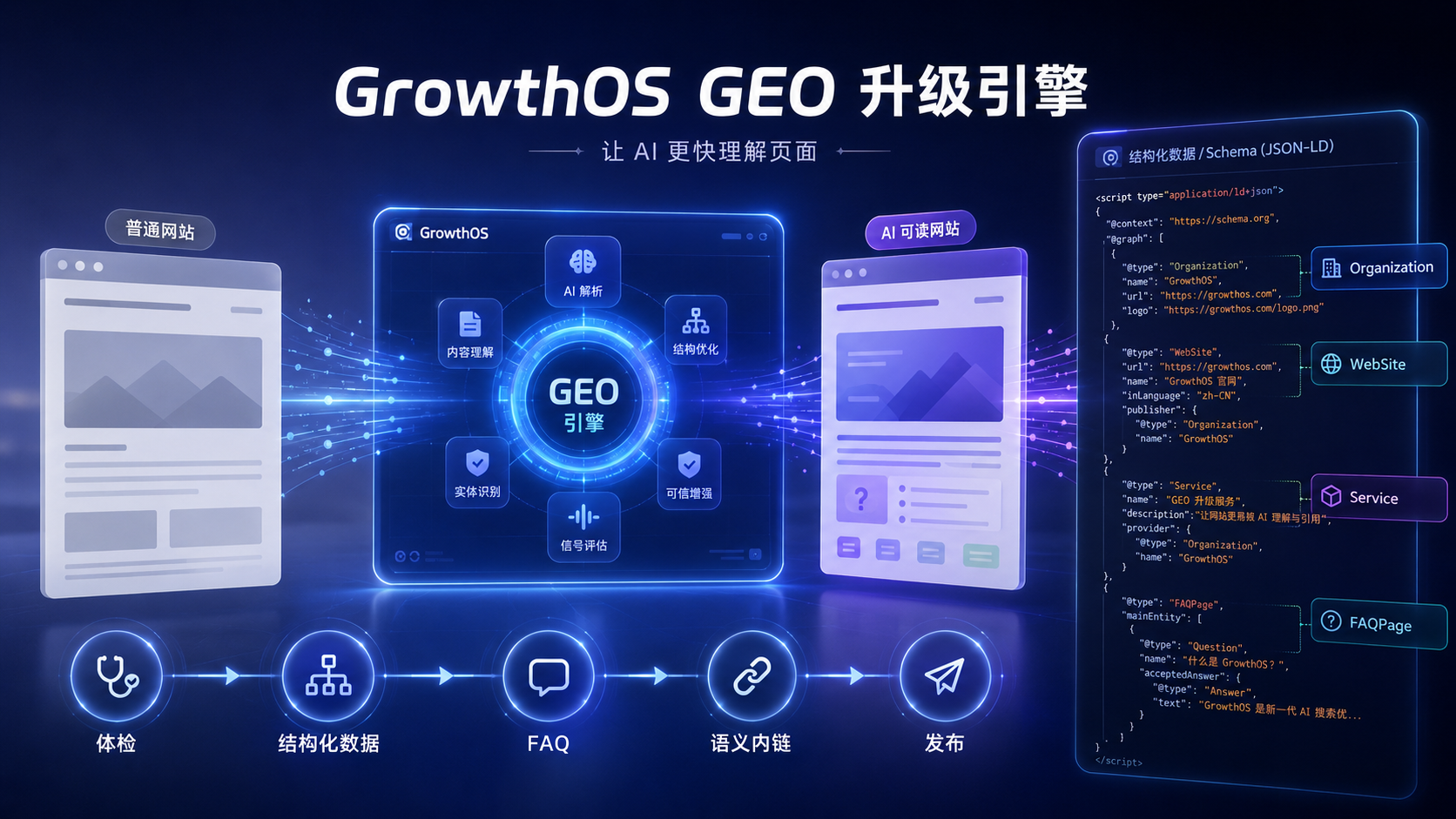
1. Website GEO Audit
GrowthOS can analyze existing website pages.
The audit checks:
Whether page titles are clear; whether Meta descriptions are accurate; whether page summaries are complete; whether the body structure is reasonable; whether the page topic is focused; whether an FAQ is included; whether Schema is included; whether entities are expressed; whether internal-link relationships exist; whether the page is suitable for AI citation; whether content is repetitive, empty, or vague.
This step helps the business understand:
Why the website is currently unsuitable for AI to understand; which pages have the highest priority; which content needs to be added; which structured data is missing; which pages need to be rewritten or strengthened.
2. Generate AI-Citable Page Content
GrowthOS can generate AI-readable citation content for pages.
This content is primarily intended for search engines and AI systems and does not necessarily appear directly to ordinary users.
Its purpose is to tell AI:
What type of page this is; which organization it belongs to; what topic it covers; which entities it relates to; what services it provides; which FAQs it contains; which pages it relates to; whether the content is suitable as an answer source.
Traditional websites usually lacked this information.
Pages contained only visible content, leaving AI to guess.
GrowthOS completes the AI-readable information behind the page so that AI can understand it faster.
3. Automatically Generate and Inject Schema / JSON-LD
Many businesses do not know how to write Schema or which structures different page types should use.
GrowthOS can automatically generate the appropriate structured data based on page type.
For example:
Generate Organization, WebSite, and WebPage for the homepage; Article, FAQPage, and BreadcrumbList for article pages; Service and FAQPage for service pages; Product and Offer for product pages; Article or CreativeWork for case-study pages; LocalBusiness for local business pages; FAQPage or HowTo for knowledge-base pages.
After generation, the data can be written into website pages through a plugin, script, Head injection, or API.
Businesses can therefore complete the structured-data upgrades required for GEO without writing code themselves.
4. Generate FAQs and Q&A Content
GrowthOS can generate FAQs from page content, product materials, service descriptions, and customer questions.
For example, a GEO optimization service page could generate:
What is the difference between GEO and SEO? What kinds of websites are suitable for GEO? How long does GEO optimization take to show results? Does GEO require changes to website code? Is GEO suitable for export websites? How does GrowthOS generate structured data? How does AI-citable content help a website?
The value of an FAQ goes beyond enriching the page.
It also helps AI identify more quickly which questions the page can answer.
5. Optimize Page Content
GrowthOS can help optimize page content.
This includes:
Title optimization; Meta description optimization; page-summary generation; paragraph-structure adjustment; subheading optimization; FAQ expansion; product-information expansion; service-process expansion; case-evidence expansion; stronger entity terminology; stronger semantic expression.
This is not keyword stuffing in the traditional sense.
It makes pages clearer, more specific, and easier for users to read, while also making them more suitable for AI to summarize and cite.
6. Build Internal Links and Semantic Relationships
GrowthOS can help businesses map the relationships between pages.
For example:
Which cases should service pages relate to? Which FAQs should product pages relate to? Which services should article pages relate to? Which solutions should industry pages relate to? Which internal links should core pages receive? Which pages cover related topics but are not connected?
The goal of this step is to form a topical network across the website.
AI then sees not just one page, but an entire information system organized around the business.
7. Continuously Produce and Publish Content
GEO requires long-term content growth.
Based on the business website, knowledge base, product materials, and business boundaries, GrowthOS can generate article topics, article drafts, FAQs, summaries, structured data, and other content.
The process can be:
AI generates the first draft; a person reviews and edits it; the title, body, FAQ, and Schema are confirmed; the content is published to the website; optimization continues afterward.
The business no longer depends on fragmented writing efforts, but gains a continuous content-growth process.
Chapter 10: How Does GrowthOS Help the Official Website Become the Primary Source?
In GEO, the official website must become the company's primary source.
GrowthOS can help the official website establish a more stable information system.
1. Standardize Business Entity Information
GrowthOS can help a business organize:
Company name; brand name; official website address; logo; contact details; service regions; industry attributes; core business; core products; core services; social media links; external platform links.
This information can become part of structured data such as Organization and WebSite, making it easier for AI to identify the business entity.
2. Standardize Product and Service Descriptions
Many businesses use different names internally for the same service.
The official website uses one name. Sales materials use another. WeChat articles use a third. Customer case studies use another expression again.
This affects AI's judgment.
GrowthOS can help a business establish consistent descriptions for its products and services.
Including:
Standard name; one-sentence introduction; detailed description; suitable customers; applicable scenarios; core advantages; common questions; related cases; related pages.
Once the descriptions are standardized, the official website and external content can both develop around the same information.
3. Establish Core Page Assets
GrowthOS can help a business identify which pages should become core pages.
For example:
Brand homepage; core service pages; core product pages; industry solution pages; customer case pages; FAQ pages; white-paper pages; knowledge-base pages; comparison pages; pricing or inquiry pages.
These pages form the main body of the official website as the primary source.
External content can be distributed around these pages and provide support for them.
4. Make External Content Support the Official Website
GrowthOS's GEO approach optimizes not only the official website itself, but also builds an evidence network around it through external content.
External articles, media coverage, social content, and industry-platform introductions should all return to primary pages on the official website.
This creates the following pattern:
The official website defines the brand; external sources verify the brand; content continuously reinforces the brand; AI gradually forms a stable understanding.
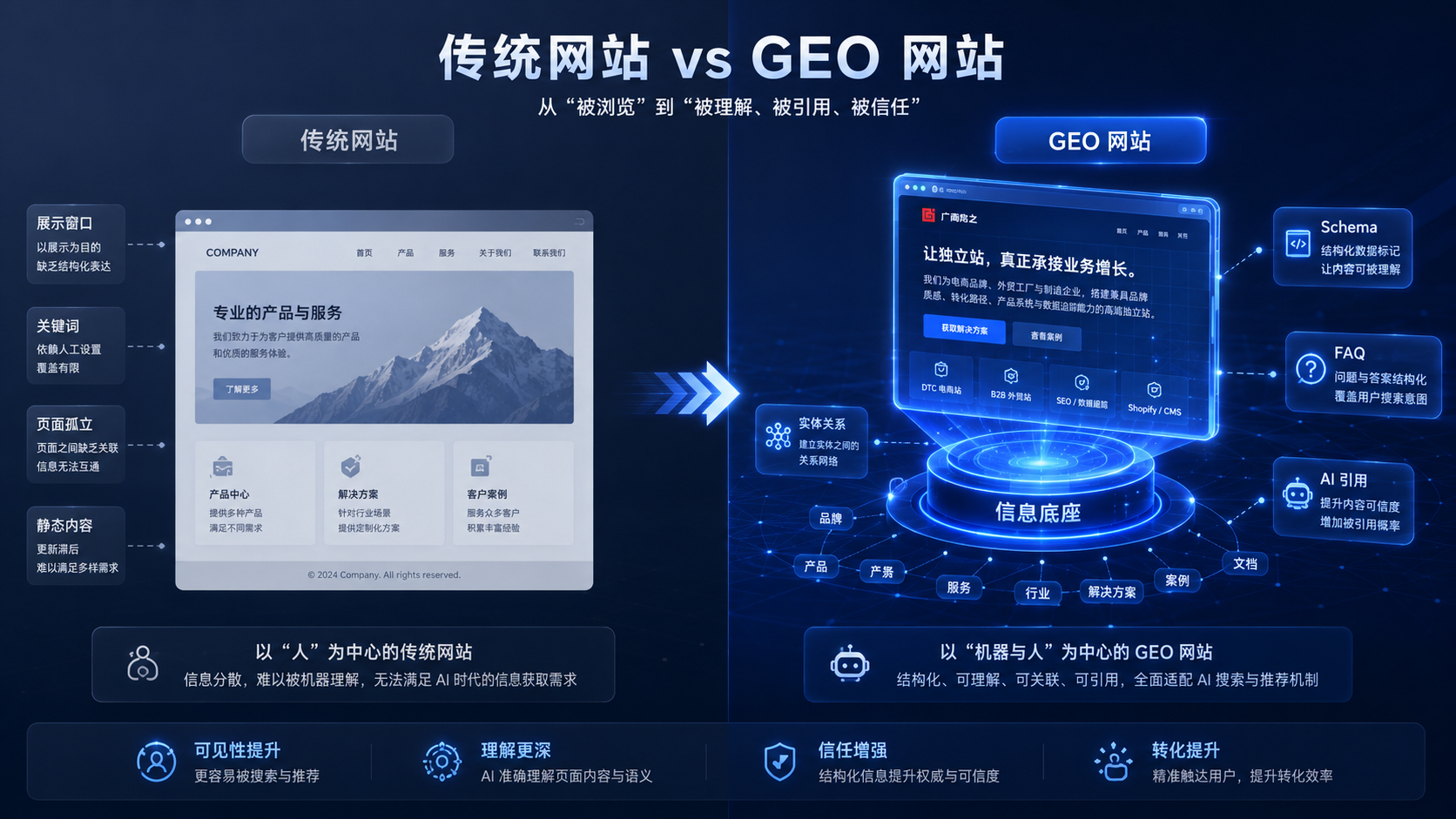
Chapter 11: Before and After Upgrading a Traditional Website
Traditional Website
Primarily for people. Centered on visual presentation. Pages are relatively isolated. Most content is promotional. SEO centers on keywords and rankings. Schema and AI-readable information are missing. FAQs are incomplete. Entity relationships are unclear. External content is inconsistent. The website is rarely updated after launch. No one receives customers after they visit. Inquiries and conversations are easily lost.
GEO-Era Website
Designed for both people and AI. Centered on information structure. Pages form a semantic network. Content develops around real questions. SEO and GEO are optimized together. Every core page has structured data. FAQs become important content assets. Company, brand, product, and service entities are clear. The official website and external content remain consistent over time. The website is continuously updated and optimized. AI can understand and cite information from the website. Customers can be received and converted by AI after visiting.
In one sentence:
Traditional websites solve the "presentation problem"; GEO-era websites solve the problems of "being understood, trusted, recommended, and converted."
Chapter 12: Why Does GrowthOS Also Need AI Customer Service and WhatsApp in Export Scenarios?
The preceding chapters discussed GEO.
GEO addresses:
How a business can be understood, cited, and recommended by AI.
But for export businesses, this is not enough.
Export websites face another practical question:
When a customer arrives, who receives them?
Overseas customers may come from different time zones.
When customers visit a website late at night to learn about products, prices, lead times, specifications, certifications, samples, or customization options, the lead may be lost if no one responds promptly.
In export scenarios, GrowthOS therefore extends GEO capabilities into AI reception and sales conversion.
In other words:
GEO makes it easier for customers and AI to find, understand, and trust you. AI customer service and WhatsApp receive customers, answer questions, capture leads, and advance conversion.
1. AI Customer Service: Give the Website a Sales Representative Available 24/7
GrowthOS can integrate an AI conversation system into the front end of a website.
Visitors can ask questions directly after entering the website.
AI can draw on:
Official website content; product materials; service descriptions; FAQs; knowledge bases; case materials; quotation boundaries; delivery processes.
It can then provide intelligent answers.
This is not generic conversation. The answers are based on the company's own business materials.
This is especially important for export websites.
Customers may come from different countries, speak different languages, and visit at unpredictable times.
AI can handle the initial communication and reduce customer loss.
2. Multilingual Communication: Reduce Loss Caused by Language and Time-Zone Differences
A common challenge for export businesses is that customers use different languages.
Customers may inquire in English, Spanish, Japanese, Arabic, French, German, or other languages.
If the human team cannot respond promptly, communication becomes inefficient.
GrowthOS can help a website provide basic multilingual reception.
Whatever language a customer uses to ask a question, AI attempts to answer in a language familiar to that customer.
This can significantly improve the efficiency of the first round of communication.
3. Automated WhatsApp Handling: Support a Core Export Communication Channel
For many export businesses, WhatsApp is one of the most important customer communication channels.
Customers may move from the website to WhatsApp or inquire directly through WhatsApp.
After WhatsApp is integrated with GrowthOS, WhatsApp inquiries can become part of the AI reception and lead-management system.
When customers ask on WhatsApp about:
Product prices; specifications; product materials; lead times; certifications; samples; customization; cooperation models.
AI can identify the intent first, then use the knowledge base to reply automatically or send materials.
If the customer's question is complex or the customer has already shown purchasing intent, a human salesperson can take over.
AI handles basic identification and material delivery, while people handle high-value communication and closing.
4. Human Takeover: AI Assists Sales Rather Than Replacing It
AI customer service is not intended to replace human salespeople.
A more reasonable division of responsibilities is:
AI handles basic front-end reception; AI answers repetitive questions; AI sends materials; AI performs initial needs identification; people handle quotations; people develop solutions; people negotiate; people close deals.
After a human salesperson takes over, AI should enter a cooldown state to avoid replying to the customer at the same time.
This creates a more natural customer experience and prevents AI from interfering with the sales process.
5. Lead Capture: Turn Every Inquiry into a Customer Asset
Many websites do receive inquiries, but fail to capture them as assets afterward.
What did the customer ask? Which country are they from? Which product interests them? Do they have purchasing intent? Did they leave an email address? What is their WhatsApp number? Who will follow up? What is the subsequent progress?
If this information is scattered across chat records, forms, WhatsApp, and individual salespeople's memories, it is easily lost.
GrowthOS can turn website conversations, WhatsApp inquiries, forms, and inquiry information into lead records.
The system can identify:
Customer name; email; telephone; WhatsApp; company; country or region; product of interest; requirements summary; intent level; communication records; follow-up status.
The website is then no longer merely a traffic gateway, but a customer-asset capture system.
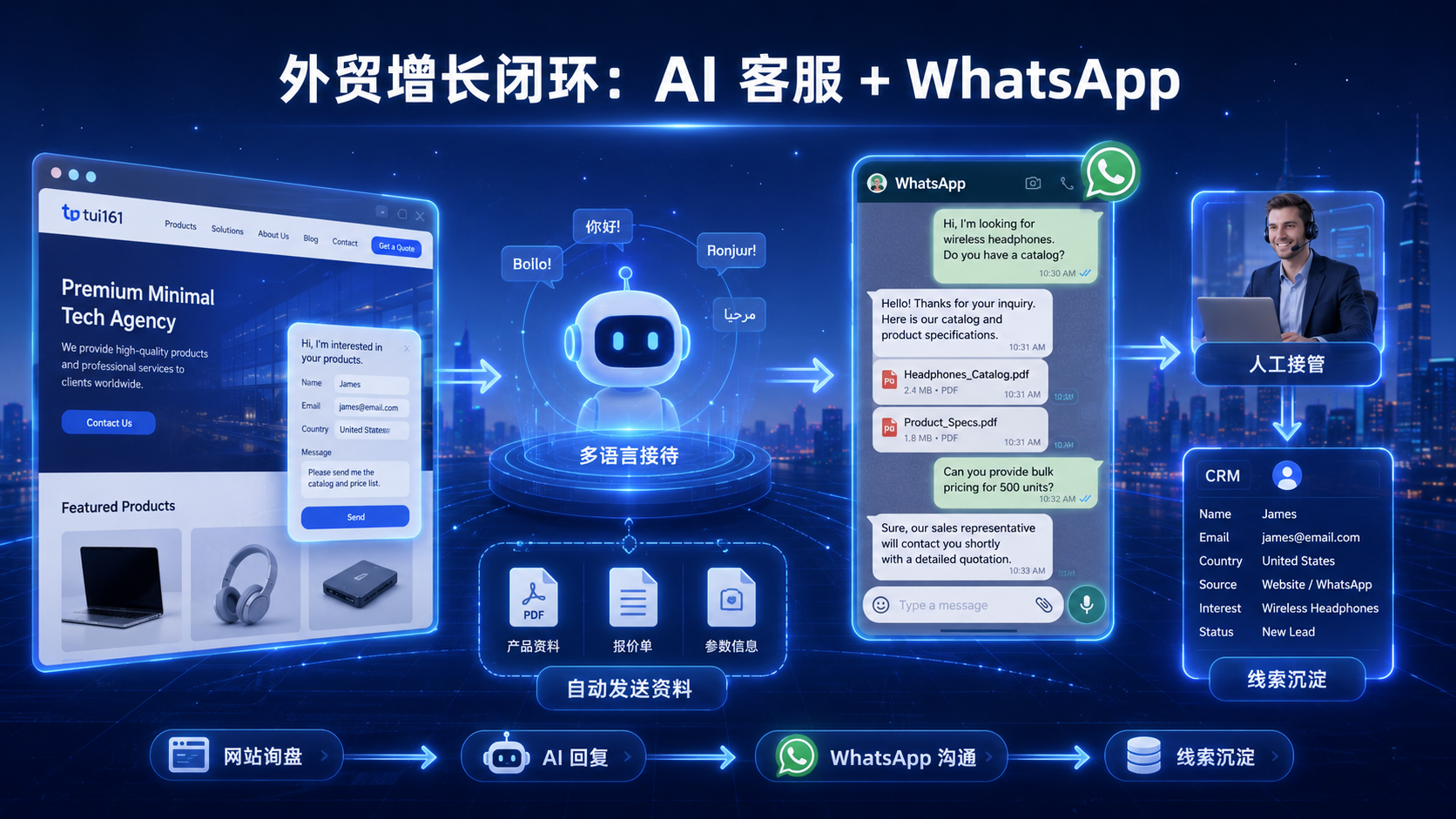
Chapter 13: The Complete Growth Loop of GrowthOS
GrowthOS ultimately aims to form a complete closed loop.
1. Be Understood
GEO audits, page optimization, Schema injection, FAQ development, and entity-relationship mapping make business websites easier for AI to understand.
2. Be Cited
Structured data, clear content, the official website as the primary source, and external supporting evidence make website content more suitable as a cited source in AI answers.
3. Be Recommended
Long-term consistency across the brand, products, services, cases, and external content increases the probability that AI will recommend the business in relevant questions.
4. Be Received
AI customer service and multilingual conversations enable customers to be received promptly after entering the website.
5. Be Converted
Automated WhatsApp handling, material delivery, human takeover, and lead capture turn inquiries into sales opportunities that can be followed up.
6. Grow Continuously
Article creation, FAQ updates, page optimization, knowledge-base accumulation, and external content distribution enable the website to continuously build content assets and trust assets.
This is the difference between GrowthOS and ordinary tools.
It does not solve only one isolated problem; it builds a growth loop around the website.
Chapter 14: Which Businesses Is GrowthOS Suitable For?
GrowthOS is suitable for the following types of businesses.
1. Official Business Websites Seeking GEO Optimization
If a business wants to be understood, cited, and recommended more easily in the era of AI search and AI Q&A, its official website needs a GEO upgrade.
2. Businesses Whose Traditional Websites Need Upgrading
If a website has not been updated for years, has a confused page structure, and lacks FAQs, Schema, internal links, and a content-growth mechanism, GrowthOS can help complete a systematic upgrade.
3. Export Independent Websites
An export independent website must be understood by Google and AI while also receiving overseas customers.
GrowthOS can provide GEO optimization, AI customer service, multilingual reception, and WhatsApp integration at the same time.
4. B2B Inquiry Websites
The most important role of a B2B inquiry website is to receive customer inquiries and capture leads.
GrowthOS can reduce unanswered inquiries and improve the quality of lead capture.
5. WordPress Websites
WordPress websites can connect to GrowthOS through a plugin for AI customer service, content synchronization, SEO/GEO optimization, and article publishing.
6. Shopify Stores
Shopify stores can use GrowthOS for AI customer service, product-content optimization, collection-page optimization, blog optimization, and SEO/GEO Head injection.
7. Custom-Built Websites and Custom CMS Platforms
Custom-built websites can connect to GrowthOS through an SDK or open API to support AI conversations, content synchronization, structured-data injection, and optimization-task callbacks.
Chapter 15: GrowthOS Does Not Replace the Website; It Upgrades It
GrowthOS does not change one fundamental fact:
Businesses still need websites.
But what businesses need is no longer a static website in the traditional sense.
Future websites should have six capabilities:
Present the business; be understood by AI; continuously optimize content; accumulate brand credibility; receive customers automatically; capture leads and advance conversion.
The value of GrowthOS is not to give a business one more plugin, but to help it upgrade from a traditional website to an AI website growth system.
In the past, the work ended when the website was built. Today, going live is only the beginning.
In the past, websites handled presentation. Today, they handle understanding, reception, conversion, and growth.
In the past, websites primarily served search engines. Today, they must also serve AI Q&A and generative recommendations.
In the past, it was enough for users to understand the website. Today, AI must understand it as well.
Conclusion: It Is Finally Time for the Website to Start Working
Business websites will not disappear in the AI era.
They will become more important.
No matter how user gateways change, every business needs a stable, trustworthy, controllable, and continuously updated source of information.
The official website is that source.
But a traditional official website is no longer enough.
Future websites must upgrade to GEO websites.
They must help AI understand who the business is. Help AI know what the business does. Help AI determine which needs the business suits. Enable AI to cite website content. Make AI more willing to recommend the business in appropriate contexts. At the same time, they must receive customers, answer questions, send materials, capture leads, and support sales conversion.
GrowthOS was created for this upgrade.
It helps businesses upgrade from traditional websites to GEO websites. It helps the official website become the primary source. It helps external content provide supporting evidence. It helps pages complete their AI-readable structured data. It helps websites continuously optimize content. It helps export businesses integrate AI customer service and WhatsApp. It helps turn every inquiry into a lead that can be followed up.
In one sentence:
GrowthOS upgrades a business website from a "display window" into an intelligent website system for the AI era that can truly be understood, cited, recommended, used to receive customers, used to convert opportunities, and used to grow.
Websites are not becoming obsolete.
They simply cannot remain in the past.
A genuinely valuable website does more than exist.
It should start working.