

GEO is not just about getting AI to mention your brand. It is about helping AI understand who you are, what you do, who you serve and why you are a credible answer. Fast black-hat publishing may work briefly, but durable GEO requires question matrices, structured website FAQ, high-quality answers, trusted sources and a coherent brand knowledge graph.
Recently, more people have started talking about GEO
Some say GEO is a new traffic entrance. Some say GEO is the future of SEO. Some teams have already started acquiring customers through GEO. But the question is: what is GEO, and how should it actually be done?
If GEO is understood only as "getting AI to recommend me," that understanding is incomplete. AI recommendation is only the result. Real GEO is helping AI know who you are, what you do, who you serve, what problems you solve, and why you deserve to be mentioned.
1. What many people are doing today is actually black-hat GEO
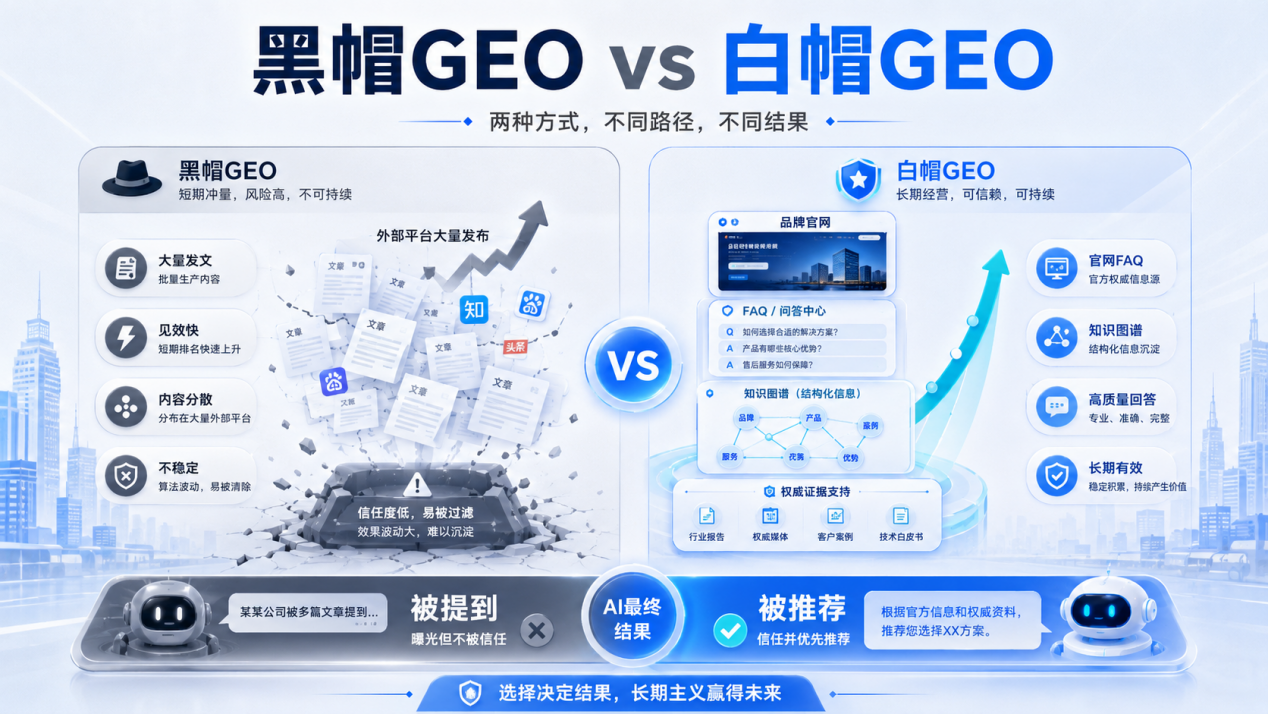
Many GEO methods you see in the market today are essentially black-hat GEO. In simple terms, they publish large amounts of content across many places so AI models are more likely to see you, ingest you and recommend you when users ask related questions.
This method does have one clear advantage: it works quickly. This is especially true when content is published on high-authority platforms such as industry media, Q&A platforms, news sources and vertical communities. AI systems are more likely to crawl these places and treat them as credible information sources.
That is why many people now talk about sources. A source is a content origin that AI is more likely to trust. If your brand, product and service frequently appear on these platforms, AI is more likely to see you as a relevant answer in a particular field.
But the problem is also obvious: this method may work in the short term, but it is not stable. Much of the content is produced only for AI ingestion. It may be low quality, incomplete, or even just keyword stuffing. Once models improve, platform rules change, or the market becomes more regulated, this approach will become weaker.
2. The long-term value will come from white-hat GEO
Besides black-hat GEO, there is a more proper approach: white-hat GEO. To be honest, not many people are truly doing white-hat GEO yet. Not because it is a bad method, but because it requires patience.
The logic of black-hat GEO is simple: publish a lot of content, occupy many positions and build volume first. White-hat GEO is different. It is long-term construction. It is not only about making AI see you, but about making AI truly understand you.
AI needs to understand who you are, what you do, what kind of customers your product or service fits, and what problems you can solve. This is harder and slower than simply publishing articles.
As models keep improving, AI will become stronger at judging information quality, credibility and structured understanding. The brands that win long-term recommendations will not be the ones that scatter content everywhere, but the ones with clear information, sufficient proof, high credibility and accurate AI understanding.
3. GEO is not "making AI recommend you"; that is only the result
Many people understand GEO as: when a user asks AI a certain question, AI can recommend me. This is not wrong, but it is only the result of GEO, not the essence of GEO.
The essence of GEO is to let AI know who you are, what you do, and what kinds of problems you can help which people solve.
When a customer searches in AI for a product, service, solution, tool or vendor, AI does not recommend a brand randomly. It forms a judgement through many information sources: this brand is related to the question; this brand has content in the field; this brand has some credibility; this brand can solve the user's current problem; this brand is worth mentioning among similar options.
So GEO optimization is not simply about making AI mention you. It is about helping AI accurately identify you as a suitable answer in specific scenarios.
4. Why is mass publishing effective right now?
Once you understand this, you can understand why mass publishing works today. A large amount of content increases the probability that AI will see you.
This is especially true when the content appears on high-authority platforms. AI can more easily build associations between your brand and certain keywords, scenarios and problems.
For example, if you provide enterprise AI implementation, and there is a lot of content online about how companies implement AI, how companies connect AI capabilities, how AI automation systems are built, how enterprise knowledge bases combine with AI, what GrowthOS is, and which company provides enterprise AI solutions, then AI is more likely to include you as a candidate answer when it responds to related questions. But this does not mean mass publishing is the best GEO method. It is only one method that is easier to make effective at the current stage. Long-term GEO should not rely on scattered, repeated, low-quality content. It should rely on systematic information construction.
5. Real GEO should build a brand knowledge graph
In my view, the core of real GEO optimization is not how many articles you publish. It is building a knowledge graph around your brand, products and services.
You can think of it as the brand resume in AI's eyes.
This resume needs to clearly tell AI: who are you? What do you do? Who do you serve? What problems do you solve? What are your strengths? What cases do you have? Why should others trust you? How are you different from other solutions? In what scenarios should customers choose you?
When this information is clear, stable, structured and mutually supported by multiple trusted sources, AI can understand you more easily and recommend you in the right questions more easily. This is the core of white-hat GEO. It is not about deceiving AI; it is about helping AI understand you more accurately.

6. How should GEO actually be done?
If you want to do GEO well, I suggest starting with three actions: build a question matrix, provide high-quality answers based on that matrix, make website FAQ the core position, and use external high-authority platforms as supporting evidence.
The core of a question matrix is to understand how customers in your industry will ask AI. They may not search your brand name directly. They may ask: is there an AI marketing tool for small and medium-sized companies? What solution can automate enterprise content production? How can AI improve sales conversion? What system can help companies connect AI capabilities quickly? What tool is suitable for GEO optimization? Is a certain vendor reliable?
These questions are your GEO entrances. What you need to do is not only write around your own brand, but build a complete question library around the real questions customers will ask. How customers ask is how you should lay out your content.

- Build a question matrix: map the questions, scenarios and decision expressions customers use in AI.
- Provide high-quality answers: explain who it fits, who it does not fit, what problem it solves, how it solves it, what cases exist and what makes it different.
- Make website FAQ the core position: the website is the brand's home field and should systematically answer questions about business, products, services, cases, strengths and use scenarios.
- Use external sources to support credibility: industry media, Q&A platforms, case reports, third-party reviews, customer reviews and professional communities can all become evidence.
7. Do not rely on junk content for GEO
When many people hear GEO, they immediately think of bulk publishing, keyword spreading and account matrices. These can certainly produce some short-term effects.
But if your content is scattered, repeated, low quality, or exists only to be crawled by AI, it will eventually fail.
Real GEO is not about filling the internet with your junk content. It is about helping AI quickly, accurately and credibly understand you on key questions. What you need to build is not noise, but recognition.
8. Customers from GEO are often very precise
Customers who find you through AI are usually very precise. They are not casually browsing information; they are looking for answers with clear questions.
When a customer asks AI: is there a vendor suitable for my situation? Which tool can solve this problem? How should my industry choose a solution? If AI recommends you at that moment, the customer is already in a clear decision scenario.
This kind of traffic often converts better than ordinary content traffic. So GEO is not only about exposure. At its core, it is an entrance for acquiring high-intent customers.
Conclusion: real GEO helps AI understand you
To summarize, GEO is not simply about making AI recommend you. Real GEO is about helping AI understand you.
You need AI to know who you are, what you do, who you serve, what problems you solve and why you deserve to be recommended.
In the short term, black-hat GEO may work quickly. But in the long term, the truly valuable approach will be white-hat GEO.
Through question matrices, website FAQ, structured content, high-authority sources and real evidence, you can help AI gradually form a stable understanding of your brand. That is what GEO should really do.
FAQ
A practical guide to black-hat GEO, white-hat GEO, question matrices, website FAQ, trusted sources and brand knowledge graphs.
How is GEO different from SEO?
SEO focuses on search visibility and clicks. GEO focuses on whether generative AI can understand, trust, cite and recommend your brand.
Why can black-hat GEO work quickly?
Large content volume and high-authority platforms increase the chance that AI sees the brand, but weak content is unstable over time.
What is the base of white-hat GEO?
A structured question matrix, clear website FAQ, credible answers, real proof and trusted external sources.
Why is website FAQ important for GEO?
It is the brand-owned source where products, services, use cases, proof and differences can be explained in a structured way.